
What Is the $27.39 Rule?

The $27.39 rule is a daily savings challenge: set aside $27.39 every day for a year and you'll end up with just under $10,000.
The math is straightforward:
$27.39 × 365 = $9,997.35
So the name of the rule is actually a couple of dollars short. If you want to cross the $10,000 mark, round it up by a cent:
$27.40 × 365 = $10,001
That's the whole rule.
And $27.40 is a much easier number to picture than $10,000. It's roughly the kind of amount you might spend on lunch, coffee, or one small thing without thinking too much about it.
But there's one part I'd change. I wouldn't wait to see whether I had $27.40 left at the end of the day. I'd set the savings aside first, then work out what I had left to spend.
How the $27.39 rule works
The rule takes one annual savings goal and breaks it into daily pieces. For the familiar $10,000 version, that's about $27.40 a day.
You don't actually need to transfer money every morning. The same goal works out to about $192 a week or $833 a month, so you can set money aside whenever you get paid.
The daily number is really just a way to make the goal manageable. Instead of trying to somehow find $10,000 by December, you know what your part of the goal looks like today.
Does the $27.39 rule actually work?
Mathematically, yes.
Set aside $27.40 every day for a year and you'll have $10,001 before any interest your savings might earn.
The harder question is whether $27.40 a day works for you.
For some people, $833 a month is realistic. For others, it isn't even close. That's where I think the rule becomes more useful as an idea than as an actual rule.
You don't have to save $10,000. If $5,000 is realistic, that's about $13.70 a day. If you're trying to save $1,000, it's about $2.74.
The useful calculation is:
Savings goal ÷ number of days = daily savings target
Your number should come from your income, bills, cash flow, and what you're trying to accomplish. Not from somebody else's challenge.
The part I'd change: save first
I used to think of savings as whatever survived until the end of the month.
That worked about as well as you'd expect. An unexpected vet bill would hit, I'd grab takeout a couple of extra nights, and suddenly the money I meant to save was gone.
So I stopped doing it in that order.
Now I treat savings like one more commitment. Income comes in, bills are already spoken for, savings is already spoken for, and then I work out what's left to spend.
That's the part of the $27.39 rule I think is worth keeping.
Decide what you're saving first. Then spend from what's left.
Your savings target isn't your spending limit
This distinction matters.
If you're following the $27.39 rule, $27.40 is the amount you're trying to save each day. It isn't necessarily the amount you can spend.
Say you've already accounted for your bills and savings. Now you're standing in a store with a $47 item in your hand.
Knowing that you saved $27.40 today doesn't tell you whether you can buy it.
What I want to know is much simpler:
Can I afford the $47?
For that, I need to know how much is left after the money I've already committed.
That's the broader idea behind how I work out what I can safely spend today.
What if you can't save $27.40 every day?
Then don't.
A savings target that doesn't fit your actual income and bills isn't much of a plan.
Start with what you want to save and see what it requires. If $10,000 means putting away about $833 every month and you only have $300 available, you've learned something important: that timeline doesn't fit your current numbers.
You can lower the goal, give yourself more time, or change some of the other numbers if that's realistic.
What I wouldn't do is pretend the $833 problem doesn't exist and hope it'll somehow work out if I'm disciplined enough.
The point is to see the numbers clearly.
What happens if you miss a day?
You haven't failed anything.
Take what you still want to save and divide it by the days remaining. That's your new daily target.
Or forget the daily deposits entirely. If you get paid every two weeks, setting the money aside on payday may make much more sense.
The $27.39 rule is a useful way to think about a savings goal. It doesn't need to become a 365-day ritual.
A better way to use the $27.39 rule
I'd use the idea like this:
- Pick a savings target based on your real income.
- Lock down your fixed bills and subscriptions.
- Subtract both commitments from your paycheck upfront.
- Convert what's left into a daily spending limit.
- Spend without guilt. The savings already happened.
You're not walking around trying to spend $27.40 less every day.
The saving has already been accounted for. Now you're making decisions with the money that's genuinely available.
How BentoMoney handles it
This is one of the reasons I built BentoMoney.
I didn't want an app telling me I'd spent $287 of a $400 category and leaving me to figure out whether that was good or bad on the 19th of the month.
I wanted the answer to a simpler question:
What can I spend today?
BentoMoney starts with the money coming in, subtracts the bills and savings you've already committed to, and turns what's left into a daily number.
As you log spending, that number changes. Spend less today and the unused amount carries forward. Spend more and you can see the effect immediately.
There are no percentages you have to hit and no rule saying you should save exactly $27.39.
You choose the savings amount. BentoMoney keeps track of what's left.
So, is the $27.39 rule worth trying?
Yes, with one change.
For the familiar version of the challenge, the number is really $27.40 a day if you want to cross $10,000 after one year.
But I wouldn't make $27.40 the rule.
I'd decide what I want to save, set that money aside first, account for everything else I've already committed to, and then find out what I have left to spend.
That's the number that helps when I'm standing at the register.
And unlike a generic savings rule, it's based on my money.
If percentage-based budgeting has been giving you more questions than answers, I wrote about that too: Is the 50/30/20 rule realistic?
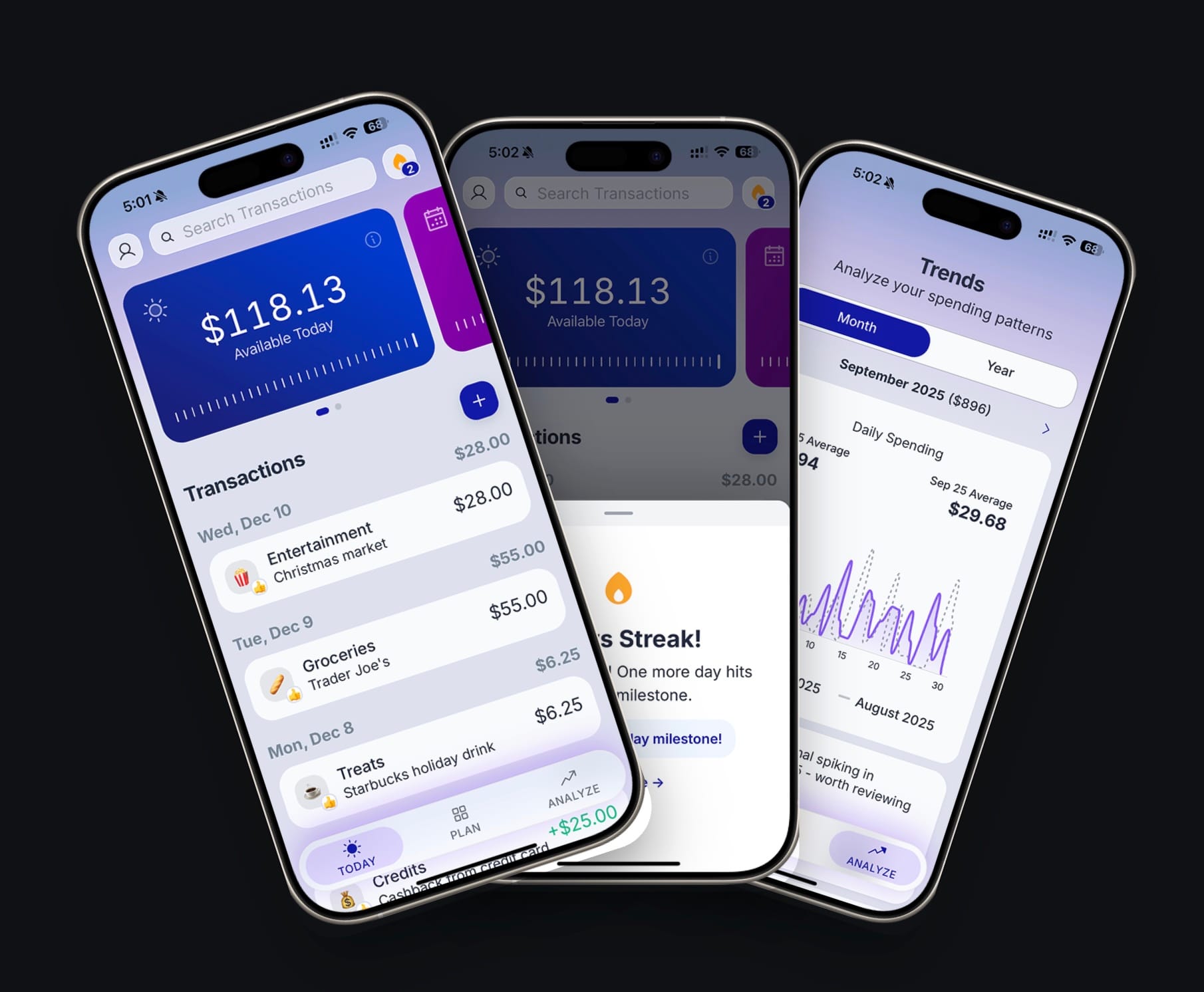
BentoMoney App
Download BentoMoney for iPhone and see what you can safely spend today.