
How much can I spend today? Your bank balance is not your budget
Most of us have done the same little ritual.
You open your checking account. You see the balance. For about four seconds, everything feels fine.
Then your brain starts subtracting things. Rent. The credit card payment. The phone bill. Groceries. Maybe that utility bill that hasn't cleared yet. Maybe money you want to save before the next paycheck.
The simple answer is to do that subtraction once, properly: take the money available for your current budget period, subtract bills, savings, debt payments, and anything else already committed, then divide what's left by the number of days the money needs to last.
If you have $900 left after those commitments and it needs to last 30 days, that's $30 a day.
Example: $900 ÷ 30 = $30 a day.
That number is usually a lot more useful than the balance sitting at the top of your banking app.
Your bank balance tells you what you have, not what you can spend
A bank balance is accurate in one narrow way. It shows how much money is in the account right now.
That doesn't mean all of it is available to spend.
Some of that money may need to pay rent. Some may cover insurance, transportation, a mortgage, or bills that haven't come out yet. Some may already be reserved for savings or a debt payment. A credit card payment may still be waiting to clear.
So a $3,000 checking balance doesn't necessarily mean you've got $3,000.
Your bank isn't doing anything wrong. It's answering a different question.
It tells you what you have.
What you need before buying lunch, filling the cart at Costco, or ordering something online is what you have left after the money that's already spoken for is accounted for.
That's the number your bank balance can't give you on its own.
The formula is simple: subtract what's committed, then divide what's left
You don't need a complicated budgeting rule for this.
The basic calculation is:
Income − bills − savings − debt payments = spendable money
Then:
Spendable money ÷ days the money needs to last = daily spending limit
Savings belongs in the first part of the calculation, not at the end.
If you've decided that $400 from this month's income is going into savings, that $400 is already spoken for. Treating it as whatever happens to be left at the end of the month is a very different plan.
What's left after all of that is the money available for normal day-to-day choices.
Food. Coffee. Grocery runs. Small household stuff. An $18 lunch. Something you didn't plan to buy until you saw it.
A $4,000 example
Say your monthly income is $4,000.
Your planned expenses look like this:
| Expense | Amount |
|---|---|
| Rent | $1,500 |
| Utilities and phone bill | $250 |
| Health insurance | $300 |
| Credit card payment | $250 |
| Subscriptions | $60 |
| Transportation | $250 |
| Savings | $500 |
| Total | $3,110 |
Now subtract that from your income:
$4,000 − $3,110 = $890
You have $890 left for flexible spending.
If that money needs to last 30 days:
$890 ÷ 30 = $29.67 per day
Call it about $30.
That doesn't mean you have to spend exactly $29.67 every day. Life doesn't work that cleanly.
Spend $15 today and you've created more room for another day. Spend $60 today and you've used some of tomorrow's room.
That's the useful part. The number shows the tradeoff while you can still do something about it.
And if percentage rules like 50/30/20 have never fitted your income particularly well, I wrote about why that happens here.
Use the number of days this money actually has to last
A calendar month isn't always the right window.
If you get paid every two weeks and the money has to carry you until your next paycheck, use 14 days.
If you're paid weekly, use seven.
If your salary arrives once a month, use the days until the next one arrives.
The question is simply:
How many days does this money need to last?
Then count the bills and other commitments that need to be covered during that same period.
The same goes for a credit card payment, insurance, savings, or anything else you've already committed to paying.
And if your spending tends to bunch up during the week, it can help to look at the same money weekly as well. Maybe Saturday is grocery day and Tuesday barely costs anything. That's fine. The daily number doesn't require seven identical days.
The point is to pace the money across the time it has to last.
Count committed money once
Anything that's already committed should be accounted for before flexible spending starts.
That usually includes things like rent or mortgage, utilities, phone, insurance, debt payments, subscriptions, transportation, and savings.
But count them once.
If your $1,500 rent is already part of the monthly plan, don't subtract it there and then record the same $1,500 again as flexible spending when you pay it. You've just made rent cost $3,000 on paper.
This is why it helps to separate planned commitments from normal day-to-day spending.
The big stuff gets accounted for first.
Then you track the spending that actually changes what you've got left.
I use the same distinction in BentoMoney. Bills and subscriptions live in the plan. Regular purchases are the things you record as you go.
There's a longer explanation in Do you need to track every expense? Why I don't record my mortgage payment.
A monthly budget plans the month. A daily number helps with the next purchase
A monthly budget and a daily spending number aren't competing ideas.
They do different jobs.
The monthly plan tells you what comes in and what's already committed. Rent. Bills. Savings. Debt. The boring stuff that has to work before you start spending the rest.
But that's not usually the question you're asking at 12:30 on a Wednesday.
The question then is whether an $18 lunch is fine today.
A monthly budget can tell you that you're technically okay.
A daily number makes that useful before you buy something.
That's why I think about it as:
The monthly number gives you structure. The weekly view helps when spending doesn't happen evenly. And the daily number helps with the next decision.
You can do all of this with a spreadsheet, a notes app, or a calculator.
The problem is repetition.
Every time you spend, something changes. An unplanned expense changes it. Spending less than expected changes it too.
Doing the calculation once is easy.
Keeping it current is the annoying part.
Expense tracking looks backward. A daily number helps before you spend
Expense tracking tells you where your money went.
A daily budget tells you how much room you have before it goes there.
You need both, but they're not the same thing.
If you only track expenses, you can end up with a very accurate picture of a bad month after the month is already over.
Useful, maybe. But a report on Sunday doesn't help much with the decision you made on Friday.
A daily number does.
And if you make a budget once but never update it when you spend, that gets stale too.
The useful middle ground is pretty simple.
Set the plan first. Then track the flexible spending that changes the plan.
That's one reason I still like manual tracking. There's a tiny pause between spending the money and forgetting about it. You buy the $14 lunch, record $14, and see what changed.
If you want to go further into that side of it, I wrote a separate guide on how to keep track of expenses on iPhone without making it a chore.
When life changes, the number should change too
The first version of your daily number will probably be wrong.
Maybe groceries cost more than you expected. Maybe the car needs something. Maybe you forgot a subscription. Maybe a normal week just costs more than you thought it did.
That's okay.
A useful budget isn't one that guessed everything correctly on the first of the month.
It's one that still tells you where you stand on the seventeenth.
If something changes, update the plan.
If you spend more today, there's less room later. Spend less and there's more. Change the amount you're putting into savings and the number changes again. Delay a purchase until after payday and maybe the whole thing becomes easy.
The daily number doesn't really tell you yes or no.
It shows you the tradeoff.
Can you afford the thing today? Maybe.
Will buying it make the next few days annoying? Also maybe.
That's the part worth seeing.
BentoMoney keeps the math visible
I originally built BentoMoney around this problem because I got tired of doing the calculation again and again.
If the method makes sense but keeping it current by hand sounds like a chore, BentoMoney is an iPhone spending tracker built around this exact question.
You add your income, bills and subscriptions, and the amount you want to put toward savings and investing.
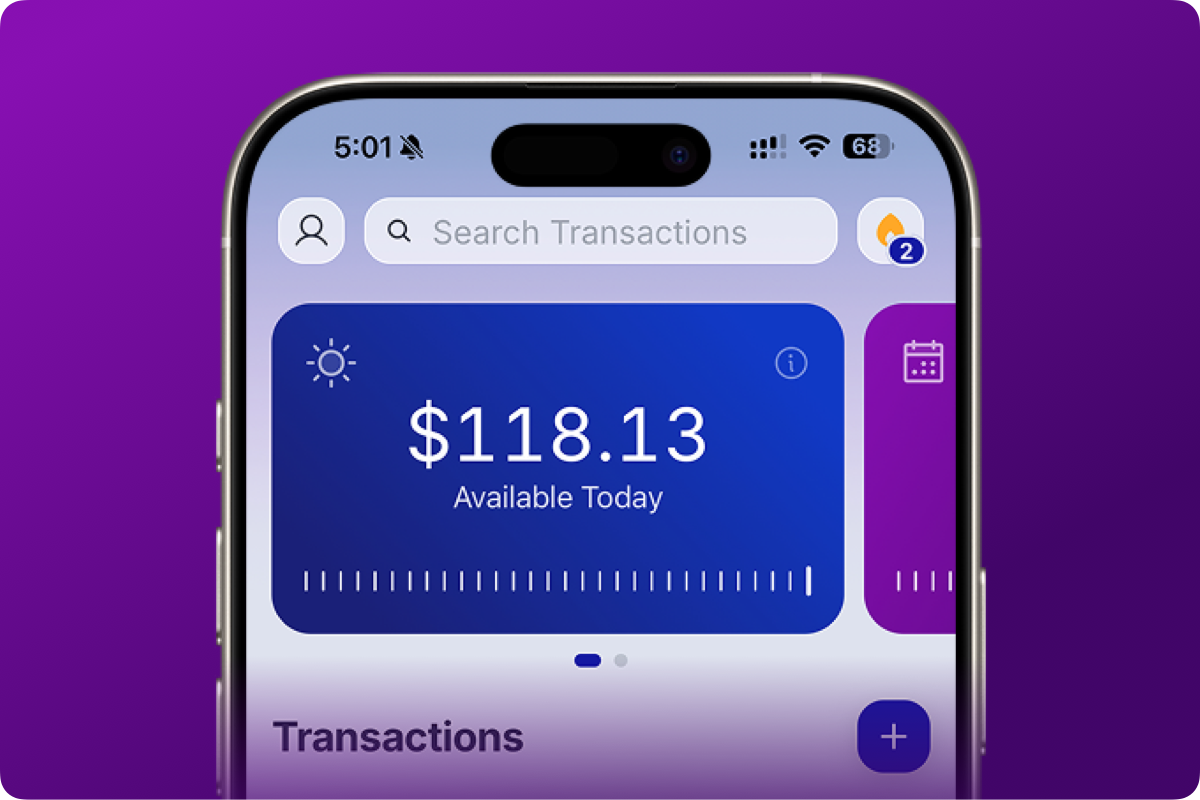
Spend less and the unused amount can roll forward. Spend more and the app shows that too.
The point isn't to punish you for buying something.
It's to keep the math visible.
Expense tracking looks backward. Available Today is there for the next decision.
If you want to see the calculation and rollover mechanics in detail, here's how BentoMoney works.
BentoMoney currently doesn't connect to your bank and doesn't require an account. Your spending data stays on your device. That's useful if you want it, but it isn't the reason for the method.
The reason is much simpler.
You need one useful number before you buy.
What to remember
- Your bank balance tells you what you have, not what you can spend.
- Start with the money available for the period you're planning.
- Subtract bills, savings, debt payments, and anything else already committed.
- Divide what's left by the number of days the money needs to last.
- Money can still be in your checking account and already be spoken for.
- Don't count planned bills again as flexible spending.
- A monthly budget helps you plan. A daily number helps you decide.
- Spend less today and you create more room later. Spend more and that room gets smaller.
- Expense tracking tells you what happened. A daily number can help before it happens.
- The point isn't to make money feel restrictive. It's to stop guessing.
If you want BentoMoney to keep that number updated for you, try BentoMoney free for 7 days.