
5 Budgeting Tips That Actually Work in 2026
Every budgeting video gives you the same list. Track your spending. Cut your coffee. Use the 50/30/20 rule. You've already heard all of it. It didn't stick.
Here are 5 things that actually change how you spend — most of which nobody talks about.
1. Stop budgeting monthly. Budget daily.
A monthly budget is basically useless by day 14.
You have no idea if you're on track. You just hope for the best and check at the end of the month — at which point it's way too late to do anything about it. You've already blown it. Congrats?
The problem is structural. Your brain doesn't think in months. It thinks in can I afford this right now?
So instead of one big monthly number, try one small daily number. Refreshed every morning. Income minus bills minus savings, divided by the days left — that's all you need. If it says $43 today, that's your answer. No mental math, no hoping.
That one change makes everything else easier, weirdly.
2. Track manually — and let the app do the math
I know. Manual tracking sounds like more work. Hear me out.
Most apps connect to your bank and pull everything automatically. Sounds convenient. Two problems: the data is usually 2–3 days behind (so you're making today's decisions with Tuesday's information), and you never feel the money leave.
That feeling is actually the whole point.
When you log a purchase manually — even just 8 seconds — you register it. You own it. It's the same reason cash feels different from a card. The friction isn't a bug, it's how you build actual awareness around what you're spending.
What you do want automated is the math. Income minus bills minus savings divided by days left in the month should happen without you touching a calculator. You handle the awareness, the app handles the arithmetic.
Manual tracking, automatic math. Best of both.
3. One number, not 15 categories
Most budget apps want you to track Food, Transport, Entertainment, Subscriptions, Shopping, Personal Care, and about 10 more categories. Nobody does that for more than two weeks. You start strong, miss a few entries, and quietly stop opening the app.
What actually works: one number. Do I have money to spend today, or not?
You check it like you check the weather. Three seconds. And honestly? That's enough.
The goal isn't to categorize your entire life into a spreadsheet. It's to make better decisions in the moment. One number does that. Fifteen categories create homework.
4. The $27.39 rule
This one's counterintuitive, but it's the thing that changes how budgeting actually feels.
If you spend less than your daily limit today, that leftover money rolls forward to tomorrow. So if your daily budget is $40 and you only spend $12.61, tomorrow you start with $67.39.
You feel the reward of being careful immediately. Not at the end of the month. Right away.
That's what turns budgeting from a restriction into something you actually want to keep doing. Spend less today, get more tomorrow. It compounds fast and it quietly changes how you think about small purchases.
I wrote the full breakdown in The $27.39 Rule if you want to go deeper on the math and the psychology behind it.
5. Build streaks, not shame
Most budgeting is built around guilt. You overspend, feel bad, avoid opening the app, and eventually just stop using it altogether. Completely normal, and completely counterproductive.
Flip it. Instead of feeling bad when you overspend, feel good when you don't.
Track consecutive days within budget. Make that the game. Three days feels good. Two weeks feels great. And breaking the streak? It hurts just enough to make you think twice before the impulse buy.
You're swapping avoidance behavior for approach behavior. One keeps you away from the app. The other keeps you coming back.
The app that runs on all 5 of these
If you want to see how BentoMoney turns the daily number, bills, savings, and spending into Available Today, How BentoMoney calculates Available Today walks through it.
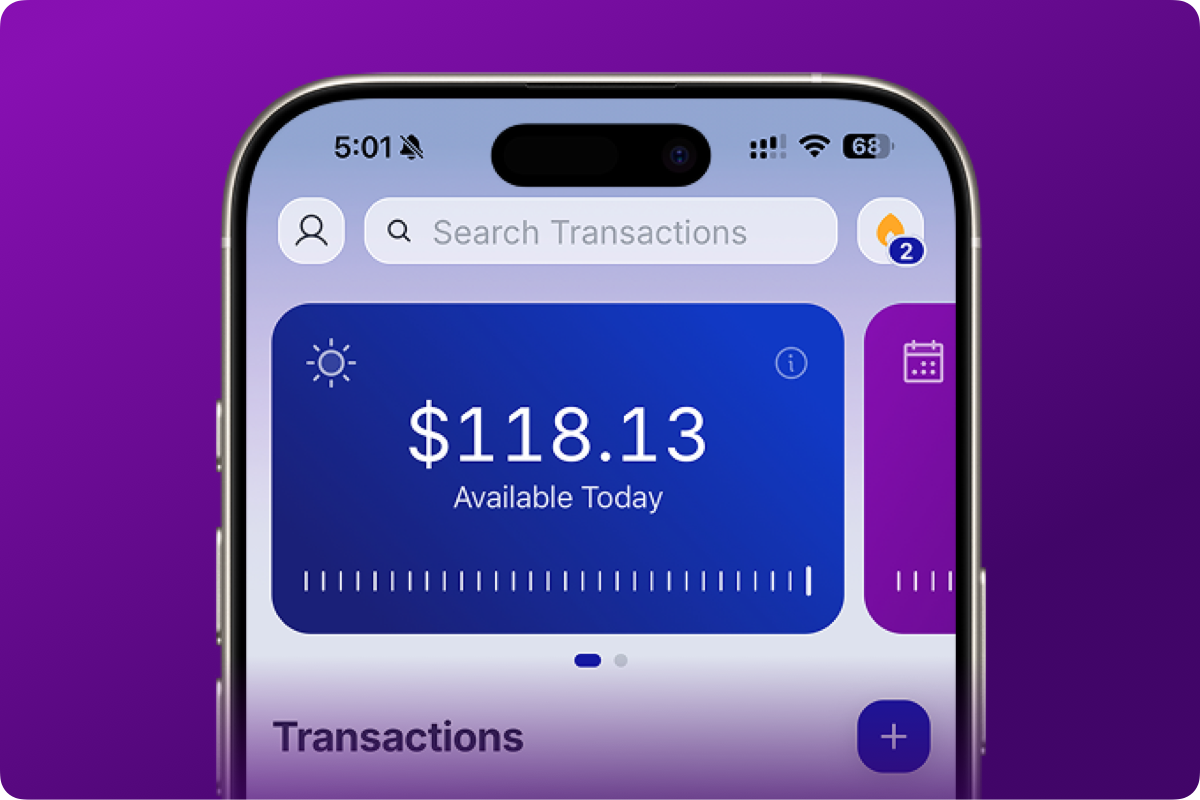
BentoMoney (iOS)
BentoMoney is built around exactly this: a daily number, manual entry, automatic math, and a streak to keep you honest.
No bank connection required. No categories to maintain. Just one number you check each morning and 8 seconds to log what you spend.
Start with one
You don't need all five. Pick one.
Honestly, start with Tip 1. Switch from monthly to daily. Try it for a week and see how it feels. Everything else gets easier from there.
— Radu 👋